THRIVING TOGETHER → MODULE 1
MODULE 1 –
What It Takes to Thrive Together
Community health centers have always played a role that extends beyond clinical care. This module explores how that role connects to a broader vision of health and well-being—and how community health centers are positioned to contribute to the conditions that allow people and communities to thrive.

A legacy that goes beyond care
Community health centers (CHCs) are on the front line for caring for community members, shouldering some of the most significant burdens of social and racial inequities based largely on poverty. The CHC movement, dating back to 1964, was led by civil rights activists committed tofinding practical and just solutions. Dr. Jack Geiger was inspired by the holistic and community-centered approaches used in apartheid South Africa to address structural racism. He and other pioneers saw the links between health, wealth, and well-being.

Realizing that people without enough food or clean drinking water would not remain healthy, even with a CHC nearby, Dr. Geiger and his team set out to address the social determinants of health. Formerly seen as issues unrelated to health, social determinants of health—such as housing, access to healthy food, employment, and education—shape how people live their lives and are now recognized as critical elements in treating each person holistically. The doctors started a farm co-op near the Mississippi CHC, where residents grew tons of vegetables each year. The initiative nearly eliminated malnutrition in the area.

A changing context for health
CHCs have become a backbone for the nation’s most vulnerable populations. They played a critical role throughout the pandemic and served as a literal lifesaver to millions. However, the pandemic’s disruptive nature further revealed the deep and growing structural inequities that persist in America. This uniquely disruptive moment in time has created the impetus to revisit the CHC’s original social justice roots to shape the future path.
The Art and Science of Thriving Together
In America and around the world, one’s chances for well-being depend on systems that are not yet built for everyone to thrive together. The Thriving Together movement is animated by the North Star vision of all people and places thriving together—no exceptions. This commitment to thriving is rooted in a belief that we can nurture and strengthen American communities where all people have a fair chance to participate, prosper, and reach their full potential. This is a measurable goal that can be tracked across the country to help us understand who in our communities is thriving, who is struggling, and who is suffering.

Well-Being (Thriving, Struggling, Suffering)
Well-being is how people think, feel, and function at an individual and societal level. Individual well-being can be classified into one of three groups based on Gallup’s Life Evaluation Index using the widely validated Cantril Self-Anchoring Striving Scale.
The index classifies people based on responses to two questions about their current and future life evaluation, each on a 0-10 scale: Thriving: Well-being is strong, consistent, and progressing. Respondents have positive views of their present life situation (7 and above) and positive views of the next five years (8 and above). Struggling: Well-being is moderate or inconsistent. Respondents have moderate views of their present life situation or moderate or negative views of their future. Suffering: Well-being is at high-risk. Respondents have poor ratings of their current life situation (4 or below) and negative views of the next five years (4 and below).
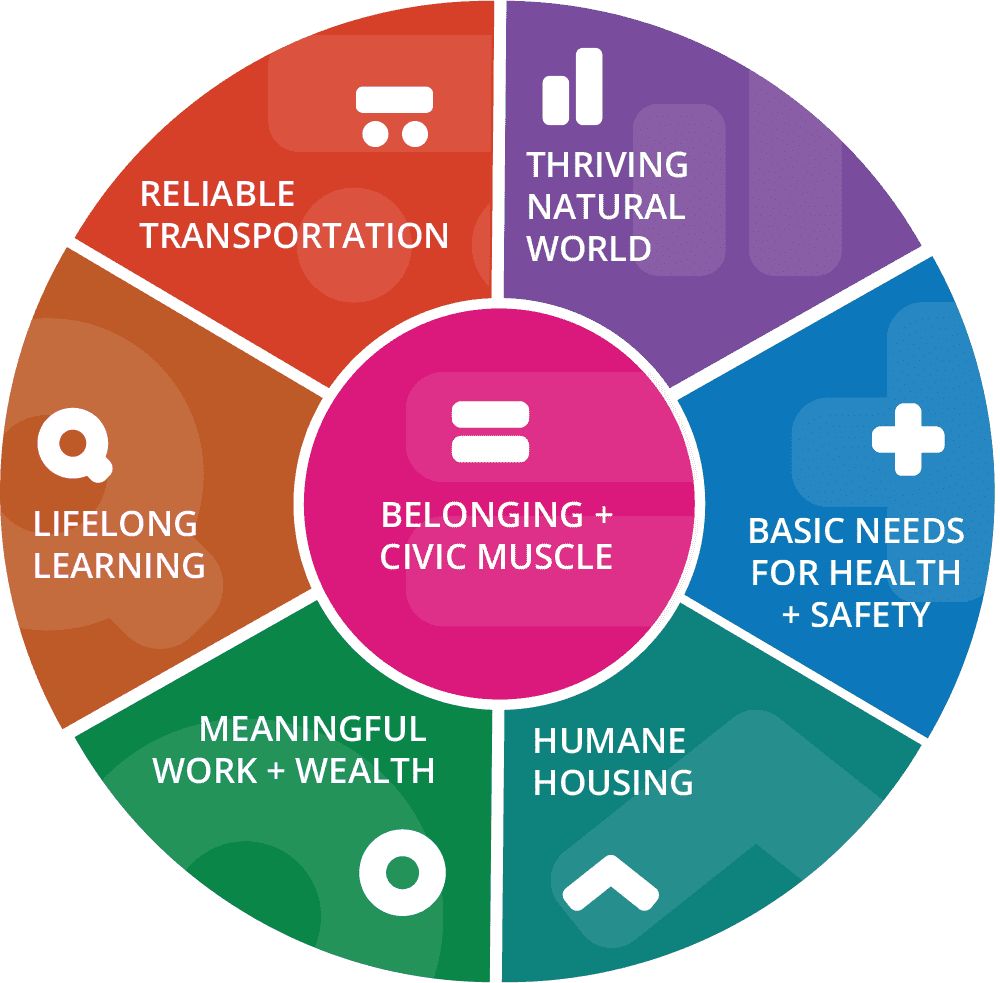
Measures of thriving, struggling, and suffering help us understand how people are experiencing their lives. The Vital Conditions help us understand what shapes those experiences—and where action is possible. They describe the essential conditions people and communities need to thrive, from basic needs, housing, and transportation to meaningful work, lifelong learning, a thriving natural world, and belonging and civic muscle.
Because these conditions are interconnected, strengthening them calls for action across organizations and sectors. For community health centers, they offer a practical lens for expanding health and well-being beyond clinical care.
Community Health Centers’ Role in Expanding Vital Conditions
Communities nationwide are increasingly realizing that people’s health potential is intricately tied to a set of vital conditions, such as meeting physical needs and fostering a sense of belonging and agency. In this context, CHCs play a unique and critical role as stewards of shared resources. They are not only service providers but also employers who rely on community health and well-being to attract, retain, and support a diverse workforce.

CHC leaders often face significant challenges in fully embracing their roles as stewards and effective agents of system change. Even those with the best intentions and a willingness to improve regional health often find themselves outside their realm of experience or lacking the necessary tools to foster a shared vision with community partners and develop a solid plan for investing in community health.
While CHCs often center their work on urgent services and basic needs, the sector is a key partner for strengthening our communities. Vital conditions are distinct and indispensable and form an interdependent system. Investing in one vital condition will strengthen the entire system, community, or region. CHCs are uniquely positioned to expand all vital conditions.
Put What You’ve Learned Into Practice
TEAM REFLECTION QUESTIONS
Where do you see your health center already strengthening the conditions that help people and communities thrive?
Which Vital Conditions feel most connected to your current work—and where do you see gaps?
Where could stronger community partnerships help you work beyond traditional clinical care?
WHAT WE’VE LEARNED
Use these prompts to explore this concept in practice.
- NCommunity health centers have long played a role in addressing the conditions that shape health, not just providing clinical care
- NHealth and well-being are shaped by daily living conditions such as housing, food, transportation, and social connection
- NThe Vital Conditions for Health and Well-Being offer a shared framework for understanding what communities need to thrive
- NThe concepts of thriving, struggling, and suffering help make visible how people are experiencing those conditions today
Explore resources and learn more