THRIVING TOGETHER → MODULE 6
MODULE 6 –
Learning and Adapting
This module explores how data can serve as a catalyst for community-centered health initiatives through meaningful measurement practices and empowering diverse stakeholders to improve well-being and resilience.

USING DATA AS A CATALYST
CHC leaders identify meaningful measurement as a high priority for improving and advancing community-centered work that establishes the vital conditions for all community members to thrive. In the medium-to-longer term, this means agreeing on, accessing, and effectively applying measures that help illuminate well-being and the vital conditions. Using data as a true catalyst for change will require seeing the art and science of measurement.
The “art” of measurement includes strategies for engaging underheard voices, valuing narratives, and reaching agreement on meaning and priorities with diverse stakeholder perspectives. The “science” of measurement includes new frameworks (e.g., the vital conditions) and measures of well-being (e.g., self-report data on thriving), with more localized data to augment these frameworks. CHCs see real value in using the vital conditions and urgent services together—and real possibilities for actionable indicators.

LEARNING AND ADAPTING
There is a strong interest in and appetite for using data more transformatively. However, some barriers need to be addressed. Moving from a data environment primarily focused on clinical and individual patient data to one that includes meaningful, community-based, upstream vital conditions will take time and intentionality. While CHCs have lengthy expertise in engaging with their patient population, in many cases those relationships can reinforce a paternalistic approach that removes communities from the opportunity to step into their power.
New ways to engage with patients, residents, grassroots leaders, and CHWs are needed. These ways should involve power-sharing practices built around metrics that are meaningful for these communities.
Creating a more robust approach to catalytic data–including more upstream community-focused data–will require data, organizational will, and capacity building for staff. The vital conditions framework and evolving set of common indicators offer CHCs an opportunity to meet the current challenges and begin to realize a more catalytic approach.

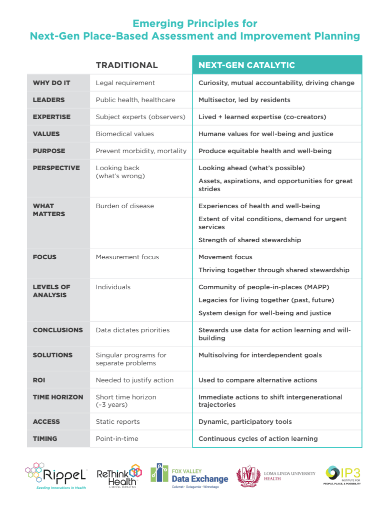
Shifting from Business as Usual to a New Desired State
From
- Getting lost in the weeds with data indicators, priorities, and relevance without an anchor of shared vision/goals
- Lack of shared definitions and understanding around community health and well-being indicators across partners and funding sources
- Convoluted data processes and indicators due to differing community assessments and lack of alignment between partner organizations
- Relying primarily on quantitative data to understand community challenges and opportunties around health and well-being
To
- Revisiting, reimagining, and clarifying CHCs’ and community partners’ vision/goals for community health and well-being, then identifying the role of data
- Establishing shared definitions and understanding of community health and well-being indicators (such as the vital conditions)
- Aligning community assessments with other assessment efforts (e.g., Community Health Assessments, Community Health Improvement Plans)-consider alignment in timeframes, survey questions, and engagement/meaning-making processes
- Using data from well-being surveys, dialogues, and other processes that bring out qualitative narratives
Opportunities to shift toward using data as a catalyst include
Put What You’ve Learned Into Practice
TEAM REFLECTION QUESTIONS
What data do we already use to understand how our community is doing?
Whose voices or experiences could help us better understand what the data means?
What is one way we could use data to support action with our partners or community?
Explore resources and learn more